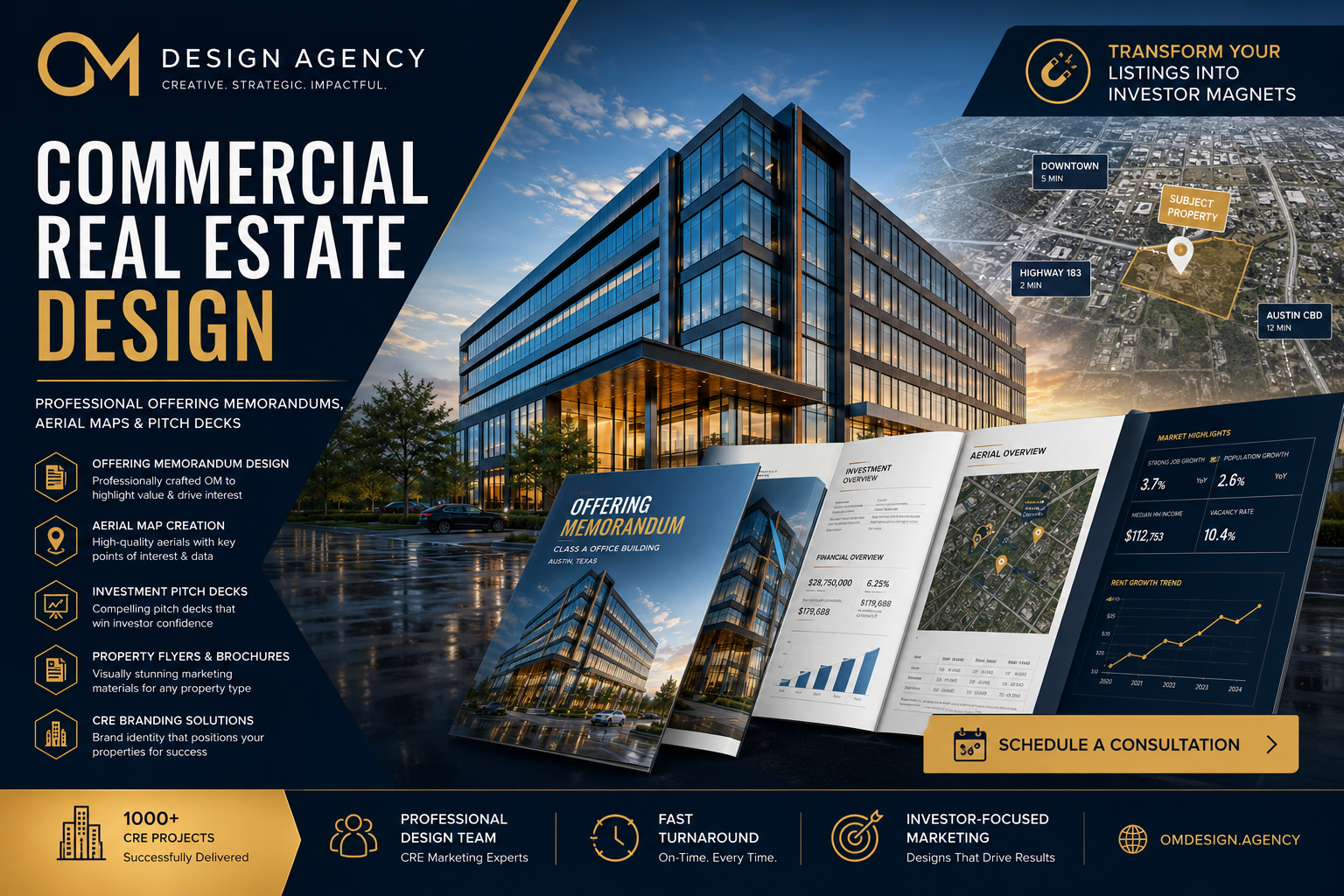
A strong commercial real estate offering is easier to market when your information is organized before design begins. As real estate professionals, you’re not just sharing facts—you’re presenting a property’s value proposition in a way qualified buyers can quickly understand and underwrite. That’s why this O&M Manual Checklist focuses on what you should have ready (content, visuals, and financials) before you hand off an OM for design. Want fewer revisions and faster launches? Start by preparing the right inputs.
Understanding the Purpose of a Commercial Real Estate Offering Memorandum
The offering memorandum is the primary marketing package for a serious real estate purchase. This is for serious investors who are actively considering the opportunity, not browsers. It’s longer, more analytical, and to do some real underwriting, as opposed to a one-page flyer.”
It also exhibits good practice in the constant synthesis of investment highlights, financial data and supporting paperwork. The typical sections are: executive overview, property description, market analysis, tenant/lease statistics, financial summary and a brief transaction terms section.
What is an Offering Memorandum and Why Is It Important?
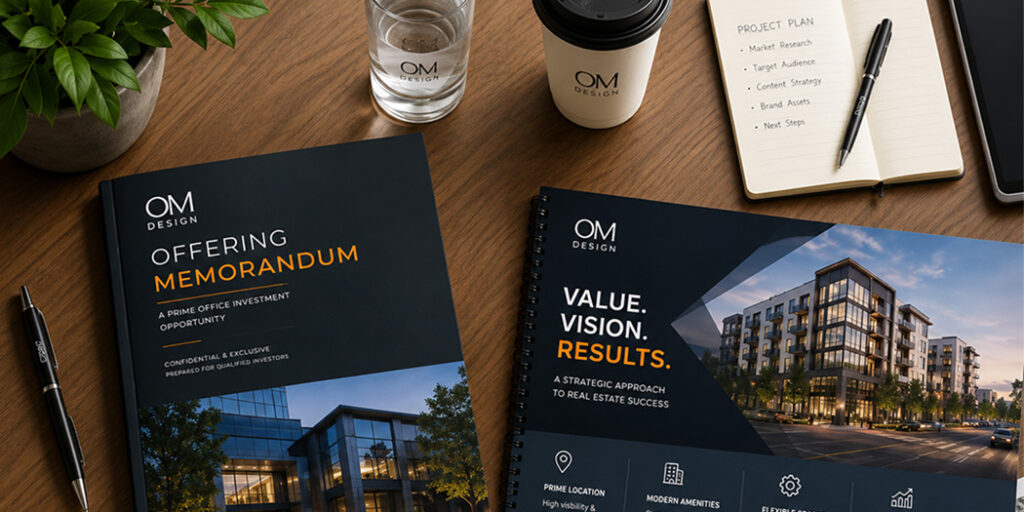
An Offering Memorandum (OM), sometimes called a confidential information memorandum (CIM) or deal book, is a formal document used to present a commercial real estate offering to qualified prospects. It’s typically shared after an NDA, because it includes details a public flyer would never show.
The OM is your investment opportunity made simple for real estate professionals to analyze. It combines the property story, the numbers and the market context into one investor-ready flow.” Buyers might dispute the assignment if the OM is not polished/complete.
What should an investor first look for in a commercial real estate OM? The executive summary. It should outline the asset, the property’s location, the asking price or guideline range, cap rate, key metrics, and a tight investment rationale that keeps readers wanting to read on.
How Offering Memorandums Build Investor Trust and Streamline Deals
When your OM is accurate, consistent, and easy to use, it builds investor trust. Regarding the purchase of commercial real estate purchasers will scrutinize every number, stress-test assumptions, and compare your package to competing offers. A clean and well-structured OM indicates a professional process.
It also cuts down the due diligence time. “If the paperwork is in order and the story matches the numbers, investors spend less time asking questions and more time moving to bids, and those are successful transactions.
Checklists to make sure you have what you need in your OM design:
- Reconciled financial data tied to the rent roll and actual operating statements
- Required sections (market analysis, lease summary, deal terms, appendices) in a standard structure
- A clear call to action with contact information and timeline details
Essential Information to Prepare Before Designing Your CRE Offering Memorandum
Before commercial real estate offering memorandum design starts, your job is to gather the necessary information so a designer (or platform) can place it without guessing. That means verified property data, a clear investment thesis, and all deal terms in writing.
Appendices Supporting Reports Tenant and Lease Information Market Summary Include information that supports underwriting. If you have this information ready to go ahead of time, your OM will build faster, read cleaner and seem more authentic to potential buyers. Let’s get into the breakdown of the O&M Manual Checklist: content and numbers.
Property Overview, Investment Highlights, and Key Financial Data
Start with a good description of the property, buyers will inspect everything. Kindly provide: property name, address, asset type, year built, renovations, size (SF), site area, parking ratio, construction, and any known deferred maintenance. Add investment highlights that detail the unique selling attributes and value proposition of the property.
Then collect sound, conservative financial information. Your costs should be based on your operating records and your rent roll should be consistent with your income projections. Buyers have expectations on vacancy and expense lines, NOI and cap rate at the asking price.
| Checklist Item | What to Have Ready |
| Executive summary inputs | Asset, property’s location, asking price range, cap rate, key points |
| Income support | Current rent roll, in-place rent vs. market rent, vacancy/credit loss |
| Expense support | Line-by-line operating expenses and recent actuals/budget |
| Output metrics | NOI, cap rate at asking price, illustrative returns labeled clearly |
Visual Assets: Photos, Maps, and Branding Elements
Buyers assess before they visit, thus your visual assets are important. Take quality pictures of your property inside, outside, and the surrounding area. Keep them high resolution. Weak visuals can indicate the broker is not taking the assignment seriously, which hampers real estate marketing.
To create a visually engaging commercial real estate OM for investors, plan for maps and graphics that quickly convey context. Location tale for non-local purchasers, supported by a bespoke graphic area map highlighting surrounding facilities, transportation hubs, and corporate neighbors.
Use this visual checklist:
- Property photographs, aerials of property showing access and environs
- Location map and area map with significant features and clear call-outs
- Floor plans or site plan, scaled and cleaned up for the rest of the document with consistent branding elements (logo, colors, fonts).
How to Design a Professional CRE Offering Memorandum: A Beginner’s Guide
Designing a commercial real estate offering memorandum is a repeatable system. Your goal is a presentation of your offering memorandum that feels clean, complete, and easy to scan, because investors are comparing options quickly across the commercial real estate industry.
Follow the suggested practices: start with the executive summary, use consistent headings, use bulleted lists when it makes things clearer, and don’t distribute drafts until the document is finished. Then, a useful O&M Manual Checklist of tools and a step-by-step procedure you can recycle for every listing.
What You Need to Get Started: Tools, Templates, and Resources
Traditional design software tools can be used to create a commercial real estate offering memorandum. Still, many teams are now turning to purpose-built platforms that can generate branded pages in less time. The trick is to employ templates that enforce a uniform format so all deal packages appear alike.
Good templates or tools for building commercial real estate OMs will let you drop in your data, images, and financial tables without worrying about formatting issues. They should also be able to update quickly when the lease terms change or the asking price is adjusted, so you don’t end up with 10 contradictory PDF copies.
Your “get started” checklist:
- Branded OM template (fonts, colors, cover & section arrangement)
- One folder for the remaining document elements: images, maps, floor plans, and appendices.
- A workflow tool or platform that allows you to enter property data once and reuse it across marketing materials
Step-by-Step Guide to Designing a Commercial Real Estate OM
Keep your OM on the move with a step-by-step strategy to avoid last-minute holes. It starts with underwriting and data collection, then goes on to narrative, visuals, and formatting. When you do it as a system, your marketing accelerates, and your real estate deal feels more under control.
First, balance your numbers. Don’t merely repeat the seller’s file; purchasers will reverse-engineer your model and find inconsistencies. And then tell the story that explains why this investment opportunity makes sense now.
Here’s how to maintain the momentum:
- Create your underwriting model and make sure it connects to the operating statements and rent roll.
- To ensure that the story is clear from the start, draft the executive summary and investment highlights.
- Design pages only after content is verified, then export a PDF sized for easy sharing and print-quality visuals
Step 1: Gather and Organize All Necessary Content
Put all relevant information in one location to start with, because when files are spread out, design slows down. Create a simple folder structure for property details, financial summary, market analysis, and appendices. If you’re going to use a platform, this is where you add the details of the commercial real estate asset once.
Then construct the table of contents before anyone touches the layout. This prevents parts from getting lost and helps you ensure you have all the inputs the purchasers need, such as lease information, deal terms, supporting documents, and so forth.
Checklists can help verify completeness in your OM design. Check that you have:
- Executive summary inputs (asset, location, asking price guidance, cap rate, investment rationale)
- A complete rent roll and lease summary (terms, expirations, escalations, options)
- Appendices ready (surveys, environmental reports, tax bills, historical operating statements)
Step 2: Plan the Layout and Incorporate Visuals
Top designers take the reader from why this deal, to how the asset works, to what the figures say in the layout. That means obvious hierarchy, uniform spacing, and easy-to-scan parts. If your pages are cluttered, investors can miss the important points.
Don’t add visual assets to your layout strategy as an afterthought. Position property images next to the property description, and include maps where location claims are made. Floor layouts and site plans should be located to facilitate leasing, access, and building operations.
Layout checklist items:
- Create a unique deal name with an appealing property image.
- Maps with annotated amenities and transport hubs to match branding elements
- Standardized headlines and page flow for quick access by investors on PC or mobile
Step 3: Add Financial Summaries and Lease Details
The financials should now be modeled in a way that investors can easily model. Your financial data should present a steady picture and performance, with well-established assumptions. Show your work. Use vacancy and expenditure logic that links to actuals. Unsupported projections are suspect.
For income-producing property, the lease details are usually the most scrutinized. Buyers want to know the tenant names, lease types, start and end dates, escalations, renewal choices, and TI/LC requirements. “Every line should balance to the rent roll so you don’t have retrades later.
Add these financial checkpoints:
- NOI, cap rate at the asking price, and expense line items shown clearly
- Lease summary table data that matches the rent roll and abstracts
- Any illustrative financing assumptions labeled as illustrative (buyers will run their own scenarios)
Step 4: Apply Consistent Branding and Review for Accuracy
Consistent branding creates a deliberate vibe for the OM. Use the same fonts, colors, and logo Treatment throughout the entire offering memorandum presentation, including charts and maps. If the document appears contradictory, purchasers may think the procedure will be inconsistent as well.
The last obstacle is accuracy. Check all numbers, titles, and claims, and make sure the executive summary, financial summary, and lease facts all match up. One inconsistency causes doubt and delays the due diligence. Shipment is only confirmed and delivered when complete.
A contemporary strategy for creating commercial real estate OM frequently consists of:
- Minimal page design with clean and powerful heading structure and scannable tables
- Custom illustrated area maps with call-outs for nearby amenities and corporate neighbors
- Digital distribution practices that reduce version confusion by keeping the most current file accessible
Conclusion
In conclusion, if you are a commercial real estate broker who wants to draw in investors and speed up transactions, then a captivating O&M Manual Checklist is the way to go. Key information such as property summaries, investment highlights, financial statistics, and high-quality visuals is carefully crafted to create a professional and compelling paper.
A well-designed OM will not only improve the property’s presentation but also build trust with the investor, leading to effective deal communication. As you work on your Offering Memorandum, go through the steps above and keep in mind the need for consistent branding and accuracy. Keep in mind that a solid OM can be a genuine game-changer in your real estate endeavors. Looking to elevate your Offering Memorandum design? Contact us today to get skilled guidance!
Frequently Asked Questions
1.What are the most important sections in a commercial real estate OM?
Buyers want an executive summary, investment highlights, market research, and financial statistics. Real estate professionals also provide a thorough explanation of the property, the tenant, the lease summary, and the contract terms. If data is missing, investors may dispute its completeness during due diligence.
2.How can I make my OM stand out to investors?
Highlight distinct unique selling elements, not generic statements. Reinforce your offering memorandum with high-quality property images, a clear description of the property’s location, and consistent branding elements throughout. Strong commercial real estate marketing and buyer confidence come from a clean structure and ease of scanning.
3.Are there common mistakes to avoid during OM design?
Yes: flaws in postings that don’t align with the rent roll or operating statements, bad pictures, and sending an incomplete draft. Get relevant information first, in accordance with due diligence best practices. Maintain consistent branding and layout. Do a final accuracy check before publishing.
4.Where can I find examples or templates for CRE Offering Memorandums?
Look for templates and tools built for the commercial real estate industry that enforce a standard structure for a commercial real estate offering memorandum. These resources help you keep sections consistent across deals and reduce formatting time. Many teams use branded OM builders to generate investor-ready documents faster.